Manufacturing Process of Tungsten Alloy Rod
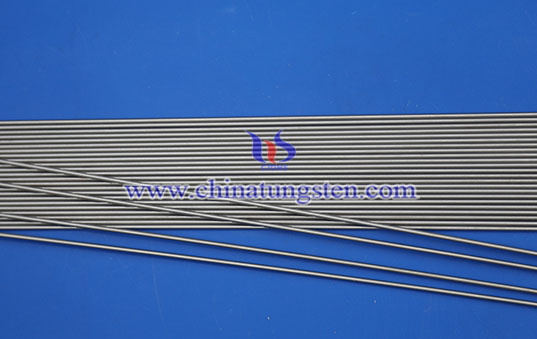
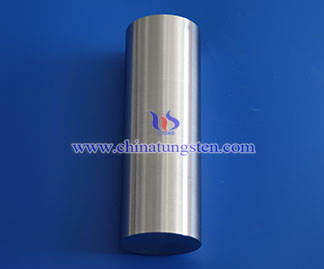
CTIA’s tungsten alloy rod is mainly manufactured through powder metallurgy. The manufacturing process includes critical steps such as raw material proportioning, powder mixing, compaction, high-temperature liquid phase sintering, strengthening treatment, and precision machining. By strictly controlling powder particle size, composition ratio, sintering temperature, and machining accuracy, CTIA produces tungsten alloy rods with high density, uniform microstructure, and stable performance.
Manufacturing Process of CTIA’s Tungsten Alloy Rod
1. Raw Material Proportioning and Powder Mixing
CTIA selects tungsten powder and alloy powders such as nickel (Ni), iron (Fe), copper (Cu), and molybdenum (Mo) for precise proportioning. The raw powders require strict control of purity, particle size distribution, and oxygen content to ensure the final sintered microstructure and performance. Through ball milling, tungsten powder and binder phase powders are uniformly dispersed, reducing segregation and improving powder homogeneity to provide a foundation for high-performance tungsten alloy rods.
2. Compaction
The mixed tungsten alloy powders are formed into rod-shaped green compacts through Cold Isostatic Pressing (CIP). CIP applies pressure uniformly through a liquid medium, promoting powder particle rearrangement and increasing compact density. A typical pressure range of 100–300 MPa is used to reduce internal porosity and improve subsequent sintering densification.
3. High-Temperature Liquid Phase Sintering
Liquid phase sintering is a key process in the manufacturing of tungsten alloy rod. The compacted rods are sintered in vacuum sintering furnaces or hydrogen protective atmospheres, with the sintering temperature typically controlled at 1450–1550°C. During sintering, binder phases such as nickel and iron form a liquid phase, promoting tungsten particle dissolution, diffusion, and rearrangement. This process forms a typical two-phase structure consisting of tungsten particle reinforcement and metallic binder phases, providing high density, good strength, and stable dimensional performance.
4. Strengthening Treatment
CTIA performs strengthening treatments such as rotary swaging and forging on sintered tungsten alloy rods. Rotary swaging applies continuous radial plastic deformation to refine the internal structure, improving density, tensile strength, and dimensional accuracy. Forging improves material structure through plastic flow, enhancing overall mechanical properties and enabling tungsten alloy rods to meet the requirements of high-strength and high-reliability components.
5. Precision Machining
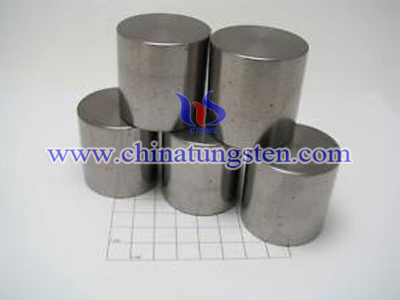
CTIA performs precision machining on sintered or strengthened tungsten alloy rods according to customer requirements. Common machining methods include:
(1) Turning: Adjusts rod diameter, length, and end-face dimensions.
(2) Grinding: Uses cylindrical grinding or centerless grinding to improve dimensional accuracy and surface quality.
(3) Polishing: Reduces surface roughness to meet precision assembly requirements.
(4) Cutting: Processes rods into specified lengths according to customer requirements.
6. Final Inspection
CTIA conducts strict quality inspections on finished tungsten alloy rods to ensure compliance with technical requirements. Main inspection items include: (1) Dimensional inspection; (2) Density inspection; (3) Composition analysis; (4) Performance testing (hardness, strength, etc.).
Manufacturing Process Flow of CTIA’s Tungsten Alloy Rod
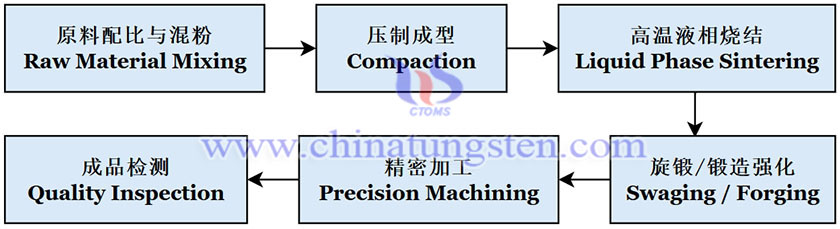
The manufacturing process flow of CTIA’s tungsten alloy rod consists of key steps: raw material mixing, compaction, liquid phase sintering, swaging/forging, precision machining, and quality inspection. The complete manufacturing process flow is shown in the picture below:
CTIA GROUP has specialized in tungsten alloy manufacturing for nearly 30 years, with expertise in producing tungsten alloy rods through powder metallurgy and precision machining. CTIA’s tungsten alloy rods are available in WNiFe, WNiCu, and WNiFeMo series, with customized grades, dimensions, and surface conditions to meet application requirements in aerospace counterweights, medical shielding, precision manufacturing, and advanced equipment.
For any inquiry, please contact tungsten alloy manufacturer: CTIA GROUP
Email: sales@chinatungsten.com
Tel: 0086 592 5129696 / 0086 592 5129595
Website: tungsten-alloy.com
WeChat:

Related Products: